

Quick Take
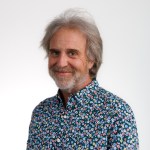
Jaron Lanier is well-known for both his accomplishments in high tech and his criticisms of its effects. But he also maintained a rigorous career as a musician. And now, back in Santa Cruz where he once lived as a busker, he's returning to his musical roots with a show at Kuumbwa and a new composition to be performed by the Santa Cruz Symphony.
For decades, Jaron Lanier has been famous as a kind of Silicon Valley truth-teller, a pioneer in virtual-reality technology who became a defiant voice defending humanist values in the face of rapacious tech profiteering. The titles of his best selling books neatly distill his vision: “You Are Not a Gadget,” “Who Owns the Future?”, “Ten Arguments for Deleting Your Social Media Accounts Right Now.”
His books, media appearances and lectures have all been in the service of criticizing a system of a hyper-capitalist business model that fetishizes algorithms and pays scant attention to the human cost. But many of those who have read his books might not even be aware of his life as a musician.
Lanier’s home in Santa Cruz is packed with musical instruments, and not the readily identifiable kind you see in the homes of many musicians. Lanier is a collector, and his home feels like a library or archive of musical instruments from all over the world — an Armenian duduk, a Turkish clarinet, a Laotian khaen, the Arabic oud. He claims to have the world’s only contra-bass oboe. But he’s not merely a collector. He’s a musician who has spent a lifetime learning the idiosyncrasies of his instruments.
Lanier is an international figure in tech who moved to Santa Cruz shortly after the pandemic. And in the coming months, he will have a new prominence on the local scene as a musician. On Oct. 7, Lanier will lead a program at the Kuumbwa Jazz Center titled “Music & the Future of Humanity,” which will also include musician friends Harper Simon, Tim Jackson, Zack Olsen and others. The Kuumbwa is billing the event as a “master class,” but, said Lanier, “I never really asked them what that means.”
The event will doubtless be a blend of performance and Lanier sharing what he’s learned about music, within and without his orientation toward technology. “I think the energy is better when it forms itself,” he said.
Several months later, in May 2026, Lanier will be on the program at a concert of the Santa Cruz Symphony. His new work will be performed on the same program as Beethoven’s Ninth Symphony.
Lanier’s life as a musician began when he was a child, following the death of his mother in a car accident. She had given him lessons on the piano and after her death, he wrote, he was “boundlessly angry and attached to the piano.”
On the local level, it’s also a misperception that he is a newcomer to Santa Cruz. In fact, he said, he lived in Santa Cruz another lifetime ago. In the late 1970s, at the age of 17, fleeing a broken relationship, he somehow ended up in Santa Cruz — “I don’t remember exactly how that happened” — living in a marginal housing situation on Beach Hill, and playing music on the old Pacific Garden Mall. He made enough money busking to stick around Santa Cruz for a while, but eventually his interest in computers lured him to Silicon Valley.
“Gradually, I found my way over the hill,” he said, “where I discovered, if I was willing to go to the sterile, ugly, smelly side of the mountain, there was all this money. The question when it comes to Santa Cruz versus Silicon Valley has always been, how much are you willing to be bored for money?”
Lanier’s achievements in tech began with a stint at Atari, and later founded VPL Research, a pioneer in what was to be called virtual reality, developing everything from software avatars to data gloves, all in the “primitive” computer era of the 1980s.
Lanier’s criticisms of the heedless embrace of tech at the expense of human-scale connections have created an impression that he is some kind of tech heretic. In fact, he’s a longtime computer theorist and researcher at Microsoft, and continues to be a key figure in the tech community. “I’m not anti-tech, at all,” he said. “I’m from the castle, man. And the reason is, I really think that we can get some things to be better.”

Even while working in tech, his musical life was also flourishing. He collaborated with music heavyweights, from Philip Glass to Ornette Coleman to George Clinton. He achieved success in the recording industry in the 1990s, with the release of his album “Instruments of Change” in 1994, in which he played a wide variety of instruments from cultures all over the world.
After decades of collecting folk instruments from cultures all over the world, Lanier feels that “I’ve kinda exhausted the supply.” But he is still swayed by the magic and mystery of music as expressed through his instruments. “I find that when you play an instrument, especially one that has a history, you have to move and breathe through that instrument, and you enter into a kind of connection with the original people who played it that isn’t available any other way.”
The role and purpose of music in human life changed fundamentally when recording technology came along. Suddenly, music was captured in time and turned into a product. A similar seismic shift might be in store for music in the age of AI, which is theoretically capable of producing music indistinguishable from organic, human-made music, bringing up basic questions about the meaning of art. Lanier said he is not anti-AI — in fact, he is excited for its potential — but he’s dismayed about the culture that is growing up around it.
“The idea that we’ll get machines to make music so people don’t have to — or that you can get music custom-made in the moment to be perfect for you — all of that misses the point so badly,” he said. “Because music isn’t a product. It’s not some kind of end point of a process. It is the process. It is life. I sometimes tease students, would you say, ‘Well, these robots are so good at sex and let’s just have the robots have sex with each other because that’ll be better sex, and I don’t even have to participate.’ That’s what they’re doing with music.”
Over the years, Lanier has landed several commissions from different orchestras around the country. In 2010, for example, the Bach Festival Society in Florida commissioned Lanier to compose “Symphony for Emilia,” in honor of Emilia Lanier, an English poet and contemporary of Shakespeare. (Lanier said he is not related to her, but that his family was named in honor of her.)
In 2026, the Santa Cruz Symphony is expected to debut a piano concerto written for the concert pianist and technologist Serene. She and Lanier have collaborated on other projects that marry music and tech. She’s even played a piano concert with a robot arm.
“I’m trying to do a pretty elaborate score,” said Lanier, “that actually requires some innovations in score-writing software.”
For years, Lanier has been at the edge of where emerging tech meets art and music, and now, at 65, he has settled in Santa Cruz, the town where he once performed on the streets for passersby.
“I found my way back here. I don’t know if the details are all that interesting, but I guess, in a way, it’s a return for me to a happy place of my youth, while the rest of the world seems to be disintegrating.”
While he continues to work in tech during the AI revolution, in Santa Cruz, he’s content to keep the fire burning in a lifelong passion for music.
“I feel more myself playing music than almost any other thing.”
Have something to say? Lookout welcomes letters to the editor, within our policies, from readers. Guidelines here.
