

Quick Take
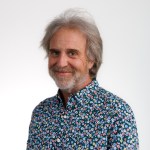
The late UC Santa Cruz icon Ralph Abraham was a prominent name in chaos theory mathematics, and a counterculture seeker of big truths. But he never viewed math as a separate arena from his search for transcendence. It was central to his conception of reality.
In the final months of Ralph Abraham’s life, Kathleen Harrison, a close family friend going back decades, would often visit him at his Bonny Doon home. And, in the quiet moments, when he was dozing, Harrison would find herself perusing her friend’s heaving bookshelves. What struck her was not only that there were always a handful of newer nonfiction titles that she had never noticed before, but the obvious rigor at which all these books had been read.
“Every single one of them — and I’m not exaggerating — every single book had dozens of little sticky notes, pink and yellow, marking every quote that mattered to him,” she said. “I would always look for an interesting title or an interesting topic, and I’d wonder if that [author] realized that Ralph Abraham read their book so carefully that it had 24, 25 different sticky notes in it.”
The other thing to note about Abraham’s books was the astonishing range of interests, a range that many might intellectually aspire to, but few in fact achieve. His interests included everything from engineering and mathematics (his chosen field), to European Enlightenment philosophy, to the science of psychedelics, to Hindu scholarship, to Jewish mysticism.
“I was surprised to discover,” said Harrison, “an entire section on Celtic mythology, which I know something about. Yet, we never got around to talking about it.”
Abraham died on Sept. 19 at the age of 88, quieting not only one of the most formidable minds in Santa Cruz County, but perhaps even in American academia. He is best known for his groundbreaking work in pure mathematics, namely in the fields of chaos theory and field dynamical systems.
At the same time, he is a seminal figure in the 1960s counterculture, particularly as it applies to the pursuit of self-enlightenment through psychedelics and Eastern mysticism (and, at least in Abraham’s case, math). For years, he was engaged in an ongoing writing project, titled “Hip Santa Cruz,” in which he documented through first-hand witnesses the “miracle,” as he called it, of the ’60s counterculture through the prism of Santa Cruz. Yet, into his 80s, Abraham was also a man of the modern world, performing as an electronica musician and writing on such contemporary obsessions as artificial intelligence.

He is the author of more than a dozen books, most notably a series of “trialogues” with fellow counterculture intellectual icons biologist Rupert Sheldrake and ethnobotanist Terence McKenna called “Chaos, Creativity and Cosmic Consciousness.”
In my interviews and encounters with Abraham over the years, he was always ready to undermine the assumption that math was his “day job” that allowed him to follow his real passion, the quest for transcendence. In fact, mathematics was part of — perhaps even the most central and relevant part of — the effort to better understand the underlying nature of existence. Math was the skeleton key, in his view, of unlocking the “structures of consciousness.”
And that mind was still spinning at the end. His wife, Ray Gwyn Smith, said that Abraham was even planning to write another book, on a very pertinent subject in 2024, before time ran out on him.
“What he was working on before he got really ill,” she said, “was about the madness of crowds and how the internet has been influencing politics.”
The coming of Abraham
The story of how Ralph Abraham ended up in Santa Cruz is full of impulsive acts and serendipity.
The defining characteristic of his early life in the 1940s was a diagnosis of tuberculosis while he was still a teen. The last-minute development of an antibiotic saved his life, but the disease put him in bed for two years at a time when others his age were in the throes of high school. In his last weeks, Abraham mentioned to his friend Kathleen Harrison that “I wouldn’t have been the person I am if I had not spent those years as an adolescent, not sure if I were going to live or die.” He called the period “the longest meditation of my life.”
As a young scholar, he followed his curiosity from electrical engineering to physics to pure mathematics, earning his Ph.D. at the age of 23 from the University of Michigan, and then landing teaching jobs at UC Berkeley, Columbia and Princeton.
UC Santa Cruz was established in 1965, based on a kind of Oxford-style model of alternative education. Abraham was exactly the kind of young thinker the new university was looking for. He was recruited to join the UCSC faculty in 1968 and, Abraham said, he didn’t take the job or the university too seriously at the time. He used the job offer as an excuse for a trip to California to see friends. He was intent on returning to Princeton when one of those friends, author Jim Houston, suggested his stop by a nightclub in Scotts Valley called The Barn.

“I saw the musicians playing inside large metal sculptures, psychedelic paintings on the wall and 300 naked people stoned on LSD dancing to the music,” he said. “I was in heaven.”
Later, as a university professor, he bought an enormous, 24-room Victorian mansion on California Street, near Santa Cruz High School. It was there that Abraham presided over a hippie-style bacchanal of students and teachers, musicians and mystics, wanderers and curiosity-seekers.
“I never lived in such an intense, hippie-crash-pad, creative-chaos kind of scene like that ever again,” said Harrison.
“It was the hub of hip Santa Cruz,” said Smith. “The Merry Pranksters, and Ram Dass, and just everybody you could think of would wind up at that house.”
Abraham had first tried LSD in 1967 while at Princeton, and by the time he arrived in Santa Cruz, he was in full embrace of the radical subculture of the time. At a rally, he wore an Abbie Hoffman-style American flag shirt and was photographed with his friend and colleague Paul Lee. That photo ran on the front pages of many newspapers across the country. Having negotiated tenure as part of his UCSC job, Abraham was protected. Lee was not, and was later forced out.
The Really Big Picture
Of Abraham’s use of LSD and other psychedelics, his friend Harrison said, “They were very helpful to him in allowing him to get to a perspective where he could see the Really Big Picture, from the minutiae to the cosmos. And to find ways of describing it more mathematically than in any other way.”

He would also often take sabbaticals and travel to India, to meditate and study with yogi masters (later, he also embraced Indian music, playing the tabla). He was developing an avid interest in the varieties of psychedelic experiences and psychedelic substances. He sought out many of the great thinkers and philosophers and mystics of the era. He was critical in the development of chaos theory in mathematics and contributed greatly to its understanding.
Those close to him say that, behind much of Abraham’s relentless curiosity about the big themes of existence was a desire to become the best person he could be.
“Ralph had such a gentle, soft sense of humor,” said Harrison, “and there was so little judgment about other people. For a person with a pretty good intuitive discernment about what a good person is, he didn’t have any mean humor in him. And I was always moved by that. How does he stay so tender-hearted and still engage with so many different people?”
“I got a chance to visit him about a week before he died,” said longtime friend and former student Peter Broadwell. “And he said [about dying], ‘There’s a chance I’m going to find a whole bunch of other things to explore.’ He was always such an inquisitive mind. He was frustrated his body was failing him. But his mind was exploring still.”
In his later years, said wife Ray Gwyn Smith, Abraham had achieved a level of fame for his groundbreaking works in mathematics, and some in the rarefied field of math spoke his name in reverence. But Abraham himself was rarely impressed by such things.
“He was just completely unaffected by his high profile,” she said. “He was just such a gentle, kind, loving person, with so much integrity. He had this very limitless kind of understanding of the world, and that was what was so exciting about him.”
Have something to say? Lookout welcomes letters to the editor, within our policies, from readers. Guidelines here.
