Quick Take
What makes UC Santa Cruz different from the University of California’s nine other campuses? Journalist Miriam Pawel’s new book, “California Dreams,” traces the UC system’s tumultuous history — and explores how UCSC’s distinctive identity emerged from a vision that quickly collided with the upheavals of the 1960s.
Many who have lived in or near Santa Cruz for a while, whether they’re Banana Slug alums or not, know all about the University of California — or at least they think they do.
But, as a new book on the UC system illustrates, the 10-campus university is a compelling example of that old parable about the blind men and the elephant. What locals know about the UC — as a neighbor, an employer, a player in the housing market, a cultural force — is mostly idiosyncratic about UC Santa Cruz specifically, and applies little to, say, UC Davis or UC Santa Barbara.

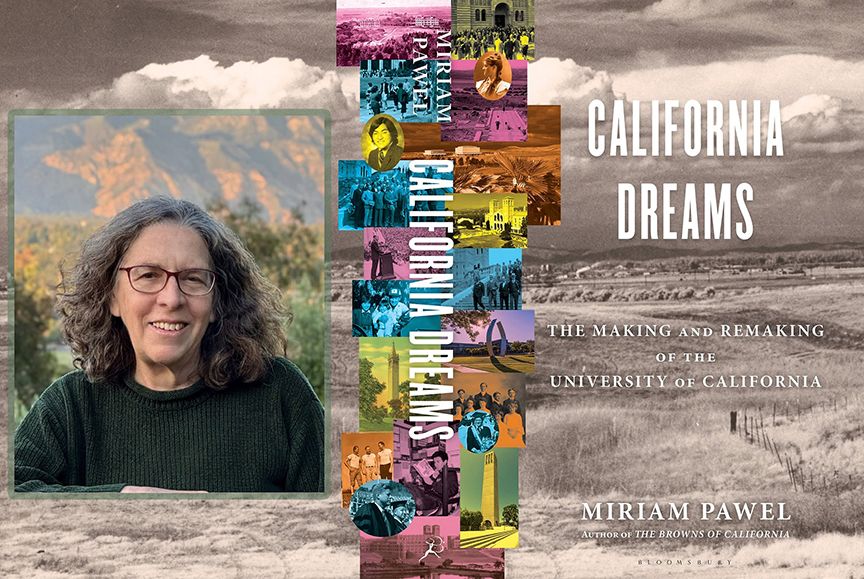
Journalist Miriam Pawel, the author of a 2018 biography of the Brown family dynasty in California politics, is back in the spotlight with her new book, “California Dreams: The Making and Remaking of the University of California” (Bloomsbury). Pawel, who comes to Bookshop Santa Cruz on Thursday, Oct. 1, said that, when she first started doing research for her book, she didn’t quite comprehend just how different each of the UC’s individual institutions were.
“They are really each significantly different,” she said, “and they each have a strong identity.”
Take, for example, UCSC and UC Irvine in Orange County. The two campuses are twins in that they were established in the same year, 1965. And they both adopted downright weird animal nicknames for their sports teams (UCI is the proud home of the Anteaters). But that’s about where the similarities end.
“[UC Irvine] was created in a very different way [than UCSC],” said Pawel, “and it had a very different student body, from the beginning.”
Pawel argues that that kind of diversity was all part of the plan, that the UC itself was less drill sergeant presiding over recruits all marching in step and more indulgent parent that allowed its “children” to grow according to their own personalities. Clark Kerr, the groundbreaking president of the UC system at the time of the opening of the new campuses in Irvine and Santa Cruz, was, Pawel writes, “committed to the idea that each campus in the system have a distinct personality and strengths.”
Kerr’s idea about UCI was to design the campus in a “concentric-circles-with-spokes” plan inspired by a 19th-century German agricultural land-use book he had read in graduate school. (Little-known fact, at least outside Irvine: the campus’s brutalist architecture was shot as the setting for the dystopian future in one of the original “Planet of the Apes” films in the early 1970s).
UCSC, by contrast, came to life on vast ranchland in the redwoods in the hills above, and quite separate from, the city of Santa Cruz. Partly to take advantage of the campus’ decentralized, Sherwood Forest-style geography, Kerr envisioned an “Oxbridge” model, in which a student’s academic life would revolve around one of several smaller residential colleges. The school would turn away from what many considered to be essential elements of college life, including letter grades and football teams.
To set up UCSC, Kerr turned to his longtime friend and former roommate Dean McHenry. The two men had had starkly different experiences as undergrads, Kerr at the private Pennsylvania school Swarthmore and McHenry at UCLA. Santa Cruz, writes Pawel, “was designed to answer the two friends’ long-standing debate over who received the better undergraduate education.” Kerr’s vision was that UCSC would emerge as a respected research institution that also put a top priority on teaching undergrads. Then, the 1960s counterculture blindsided higher education.

“I think Kerr considered Santa Cruz to be one of his greatest disappointments,” said Pawel. “He considered it a failure.”
As the anti-war movement and the sex-and-drugs ethic overtook UCSC, Kerr and McHenry, the indulgent parents, became the bad guys on campus.
“The whole concept of focusing around each college exclusively falls apart pretty quickly,” she added, “and in some ways, there’s an ongoing struggle over what is the identity of Santa Cruz. A lot of the other campuses have much clearer identities. Santa Cruz is having trouble articulating that, as the initial concept kind of broke down. Combined with what’s happening in the world at that point in time in the late 1960s, with the anti-war movement in particular. Santa Cruz is a hotbed for all of that, and if you talk to people who were at Santa Cruz in those early years, they hated Kerr and McHenry. They were like the enemies.”
“California Dreams” is not, says Pawel, a comprehensive history of the UC system. To keep the task manageable, she decided to exclude many of the important sectors of the UC, including its hospitals and labs, its law and professional postgrad schools, and its sports teams. Her focus was on how a UC education transformed the lives of many of its undergrads.
The book’s scaffolding is built on profiles of five people, including Clark Kerr, whom Pawel calls “the single most influential person in shaping the University of California.” It also features the stories of psychologist Milicent Shinn, the first woman to receive a doctorate from the UC, in 1898; teacher and historian Kenneth P. Bailey, who was UCLA’s first doctoral candidate; farmer and writer David Mas Masumoto, whose passion for organic agriculture was launched at UC Berkeley; and Mexican-born scholar Jose Alamillo, whose journey took him from the lemon fields of Ventura County to UC Santa Barbara, and eventually to a doctorate at Irvine.
Pawel said that telling the story of the UC’s history, beginning with its founding shortly after the Civil War, required that she take her profiles from the long scope of the university’s history.
“I wanted people who moved me through time, and could anchor [the reader] in different parts of the history.”
In the end, Pawel’s look into the UC’s history is a taking-stock moment of the university’s ideals, as articulated in the beginning: to establish it as a constitutional entity, independent from the state legislature or governor, a freedom for each school to develop its own character, a commitment to reflect the racial and cultural composition of California as a whole, and to keep it affordable for all, what famous alum Joan Didion called “California’s best idea of itself.”
The book jumps off from those noble beginnings to track how the UC navigated the wild swings of history, student protests and social movements, and issues like academic freedom and cultural sensitivity, from the system’s most high-profile campus in Berkeley to its newest in Merced. Pawel said that she has been inspired by the passions of all those blind men and their experience with their part of the elephant.
“Californians have this real connection to their university in a way that you don’t find in other states,” she said. “That’s a real force that I find fascinating. They love it. They hate it. They fight with it. They’re proud of it. They’re disappointed in it. It’s like a family. And that’s what makes such a critical part of California’s history and identity.”
Miriam Pawel will be at Bookshop Santa Cruz, 1520 Pacific Ave., on Thursday, Oct. 1, at 7 p.m. The event is free.
Have something to say? Lookout welcomes letters to the editor, within our policies, from readers. Guidelines here.