

Quick Take
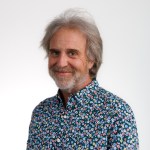
Under the leadership of new executive director Dennis Bartok, Santa Cruz’s long-standing arts nonprofit The 418 Project is undergoing a "rebirth" by expanding its traditional dance focus into adventurous, self-produced programming.
I’m standing in the corridor that leads to one of the theaters at The 418 Project in Santa Cruz, the kind of quiet, dimly lit, impeccably air-conditioned liminal space that anyone who has ever been in a movie theater would recognize (though this one is covered in a kind of deep green faux foliage that no multiplex would tolerate). I’m having a conversation with the creative leaders at The 418, and we’re talking about possibilities and the future.
Aiyana Deyoung, the organization’s programming manager, brings up a subject that, I had to admit, was not something I knew much about.
“Do you know what a ‘sound bath’ is?”
A sound bath — sadly, the term is metaphorical; there is no warm water involved — is an experience associated with meditation and spiritual practice in which participants, often lying down, are exposed to specific sonic vibrations, from chimes, gongs, bells or Tibetan singing bowls for the sake of mental health or spiritual well-being.
Deyoung mentions sound baths in the context of what conceivably might be offered to the public in the coming months or years at The 418, a longtime arts and performance nonprofit in downtown Santa Cruz. Brainstorming of this kind has been in vogue at The 418 in recent weeks, since the appointment of filmmaker Dennis Bartok as its new executive director. Bartok is encouraging that sense of what-if at an organization that has always been focused primarily on dance, movement and community. These days, however, it’s trying to reinvent itself without abandoning its core mission.
Bartok brings an ideal skill set and résumé to an arts organization looking for new adventures. He moved to Santa Cruz just a couple of years ago from Los Angeles with his wife, Marja, partly because Marja grew up in Santa Cruz. A graduate of the Tisch School of the Arts at New York University, Bartok served for more than a decade as the head of programming at the Los Angeles-based nonprofit American Cinematheque, which has developed a broad culture of world and independent cinema in the heart of box-office-obsessed Hollywood.
He also runs a film restoration and distribution business called Deaf Crocodile and, in recent years, he ran programming at the Philosophical Research Society in Los Angeles, which is devoted to mysticism, folktales, the occult and other forms of esoterica.
Taken together, Bartok’s interests suggest that The 418 is interested in bringing in films, theater, discussion groups, lectures and other performance events to illuminate non-mainstream, arcane, mystical, even secret-society kind of programming.
“Santa Cruz is already very woo-woo,” he said, in the context of his plans for programming at The 418. “I don’t think you could be a really great arts organization in Santa Cruz without embracing ‘The Woo.’”
Last Friday, Juneteenth, The 418 hosted the kind of event that exemplifies Bartok’s new approach. It was a movie double feature focused on the profoundly eccentric cosmic explorer and jazz great Sun Ra, including a brilliantly weird 1974 sci-fi curiosity scripted by the artist himself, followed by a more traditional contemporary documentary on the man and his legacy.
Bartok introduced the film to a crowd of about 100 people by relating a story of how, as an NYU film student in the 1980s, he would see Sun Ra’s name on the marquee of New York jazz clubs, but never bought a ticket to a performance because “I was just a dumb kid.”

“My aim is to really broaden the scope of the programming,” Bartok told me on a sunny afternoon at Abbott Square. “And that could include live music, author talks, book signings, magic lantern shows, shadow puppet shows, a really wide range of events that also encompass cultural and literary history, mythology, mysticism, esoteric studies, all of it.”
Already scheduled later this summer are films featuring Taiwanese glove puppets and Swedish mystical artist Hilma af Klint, as well as a Soviet-era sci-fi murder mystery from 1979, in Estonian with English subtitles. This isn’t exactly anyone’s idea of mainstream programming, and they are the first steps toward creating the kind of adventurous arts culture you would expect to find only in major cosmopolitan cities.
An author-talk series kicks off July 8 with historian Eliza Swann discussing her new book, “The Alchemical Imagination.”
At the same time, The 418 – which has a paid staff of about a dozen people – is hoping not to disrupt the schedule of events it’s offered to Santa Cruz for more than three decades.
The 418 Project was established in 1993 at a since-demolished dance studio on Front Street. (The organization’s name is a reference to the original studio’s street address: 418 Front St.) The focus at the time was purely on dance, both performances and classes/workshops open to the public. The 1990s represented an explosion of a variety of dance forms in Santa Cruz, from African to Caribbean to modern dance.
In 2021, The 418 moved into its current location at the old Riverfront Twin movie theater on River Street, raising money and purchasing the building outright. Since then, with three separate spaces in the building, it has maintained its bustling schedule of dance classes and workshops, and has also served as a kind of de facto community center for queer, nonbinary, LGBTQ and other marginalized identities.
Bartok insists that his emphasis on film, esoterica and other possible fringe art performances is not a new orientation for The 418, but simply an add-on to the dance programming already in place. Still, he said, the organization to this point has mostly operated as a rental space for outside presenters.
“Most of it has been rentals to other organizations,” he said, “as opposed to [The 418] generating its own programming. They’ve done some of that, but my aim is to increase what The 418 is offering to the public, so that most of the events are programmed and generated by us.”
What The 418 did generate and produce in recent years includes productions from a theater group called Muse of Fire and the long-running variety show “What is Erotic?” Muse of Fire is now on hiatus; “What is Erotic?” is in need of a new artistic director, and the future of the show is uncertain.
Abby Pistoni is the chair of The 418’s board of directors, and was directly involved in the hiring process that landed Dennis Bartok. She said that her team interviewed Bartok in the film-screening theater space in the building, the 160-seat space largely unchanged since it was a first-run movie theater.
“He looked at the seats,” remembered Pistoni, “and one of the first things he says to us is, ‘I want to fill all these seats, and I think I can do it.’ So we were very intrigued by that.”
Pistoni referred to Bartok as a “big manifester and an even bigger visionary.” She underscored that the organization will continue to offer dance space for locals. (What was once the movie theater’s lobby has been transformed into a dance studio.) But she also calls the current moment The 418’s “third evolution.”
“It’s a bit of a rebirth,” she said. “What’s happening is that The 418 is also going through a rebranding process. We’re not only a dance organization, not even just a performing arts organization, but a full-on arts organization.”

Bartok said the upcoming summer will be a transition phase at The 418, and by the fall or early winter, he hopes to have three or four self-produced events every week, and by next summer have its own generated programming in both theaters four to six nights per week – which could mean live music, theater, standup comedy, book events or even an occasional sound bath.
When Bartok first moved to Santa Cruz, he worked at reviving the city’s arthouse cinema culture and investigated reopening The Nickelodeon to create something similar to what he had in Los Angeles at the Philosophical Research Society and American Cinematheque. It turns out that The 418, with its movie-house capabilities and its efforts to create something new, was just what he was looking for all along.
“Hopefully,” he said, “the community here in Santa Cruz and Watsonville … and Salinas, down to Monterey, Carmel, and San Jose … people will go, ‘Oh, wow, I really want to see that event.’ And that’s my goal — we’re going to offer a lot of different things to different communities and involve a lot of different communities here. That’s what I did down at PRS in L.A., and at the American Cinematheque, and it worked out really well, and I’m hoping we can do that here in Santa Cruz.”
Have something to say? Lookout welcomes letters to the editor, within our policies, from readers. Guidelines here.
